 Chameleon
uPVC Spraying Cost: What You’re Actually Paying For
Search for uPVC spraying cost and you will mostly find price tables. A number next to the word "window", a number next to the word "door", a total at the bottom. They are easy to publish and easy to read, and they are close to useless when the quote lands on your doormat and does not match.
The reason is simple. Price is not an input. It is the output of a series of specific choices: which coating system is being used, how much time goes into preparation, how the property is accessed, which colour you have picked, and how long the installer is willing to stand behind the work in writing. Change any one of those and the price moves. Two quotes for the same house can differ substantially and both be honest, because they describe two different jobs.
This guide works the other way round from a price table. It sets out what you are actually paying for, so that when you read your own quotes you can see which choices each one has made, and whether a lower number means you are getting a better deal or a shorter-lived one.
How each item is priced, and what moves it
Sprayers price uPVC by the item, but the item is really shorthand for surface area, edge count and fiddliness. That is why two windows on the same house can be quoted differently.
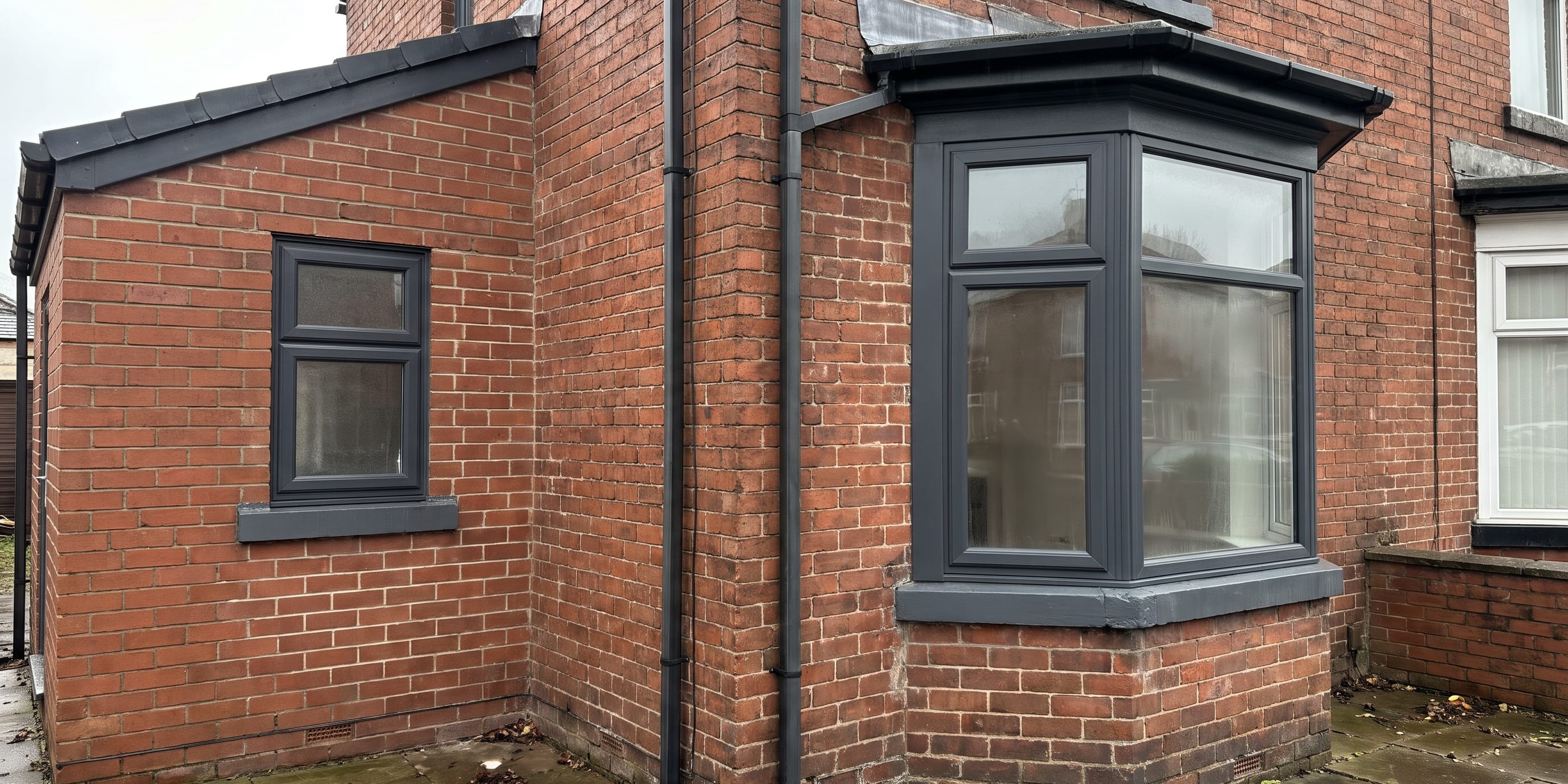
Windows. A standard casement is the baseline unit. What pushes it up is the number of opening sashes (each one has edges, rebates and a frame return that all need coating), the amount of glazing bar, and height. Anything reached from a ladder or tower costs more than anything reached standing on a driveway, because the time spent moving and securing access is real time. Bay windows are priced higher than their footprint suggests because of the extra corner posts and the masking complexity around them.
Doors. A front door usually prices well above a window of similar size. It has two faces plus the full edge set, it carries furniture that either comes off or gets masked precisely, and it is the thing visitors stand a foot away from, so the finish standard is unforgiving. Composite and panelled doors with mouldings take longer again. A sprayer who prices a door the same as a window either has not looked at it properly or is not planning to do the edges.
Garage doors. Up and over or sectional doors are large, simple surfaces, which makes them efficient per square metre. The cost drivers are different: surface condition (many have oxidised badly), whether the door needs to be operable the same day, and how much of the surrounding brickwork and driveway needs protecting from overspray.
Conservatories. These are the most variable item of all. A conservatory is mostly frame and glazing bar, so the surface area is high relative to its size, and the roof bars are both awkward to reach and awkward to mask. Expect a conservatory to be quoted closer to a run of several windows than to a single item. Internal spraying, where it is wanted, is a separate conversation about containment and ventilation.
Full house. Done as one job, a whole property is normally priced below the sum of its parts. More on why that is below.
You will notice there are no figures in that section. That is deliberate. Regional labour rates, access requirements and specification differ enough that publishing a national average would give you a number to argue with rather than a tool to think with. What you can do is check that your quote prices these items in a way that reflects their actual difficulty. If every window on the quote is the same price regardless of size, sash count or height, the quote has been estimated from the kerb.
The paint system is the biggest single variable
This is where most of the gap between a cheap quote and a considered one actually lives, and it is the part least often explained to customers.
uPVC is a difficult substrate. It is smooth, low energy, flexible, and it moves significantly with temperature. Paint does not naturally want to stick to it. The whole job is a problem of adhesion, and the coating system is how that problem is solved.
A proper 2-pack system, often written as 2K, uses a base and a hardener that are mixed immediately before spraying. They cure by chemical reaction rather than simply drying, which produces a hard, cross-linked film that bonds tightly, resists UV, and flexes with the frame instead of cracking off it. This is the same family of technology used on vehicles for the same reasons: exposure, movement and the expectation of years rather than seasons.
A single-pack or general-purpose exterior coating applied to the same frames is not the same job done cheaper. It is a different and shorter-lived product. It will usually look acceptable on the day. The difference appears later, in gradual chalking, in colour drift on south-facing elevations, and most commonly in adhesion failure at edges and around handles where the film is thinnest and the movement is greatest.
So when you compare two uPVC spraying quotes, the first question is not how much. It is what. Ask for the coating system by name. A firm using a quality 2K system will tell you without hesitation, because it is the thing they are selling. Vagueness here is informative.
What a properly itemised quote looks like
A quote that is one line and one number is asking you to trust rather than to check. A quote you can read against this guide breaks out at least the following.
Preparation and abrasion. This should be described, not assumed. uPVC needs thorough cleaning to remove the chalky oxidised layer, grease and residue, followed by mechanical abrasion to key the surface. Degreasing alone is not preparation.
Primer or adhesion promoter. The quote should say whether an adhesion primer is being used and on what. This is the layer that does the structural work of bonding the system to the plastic.
Number of topcoats. Two is normal. One is a cost saving that shows up as patchy coverage, particularly on strong colours over white.
Masking and protection. This is the single most underestimated line on any spray quote. Glass, seals, brickwork, drives, cars, neighbouring property and planting all need protecting. On a full house, masking can take comparable time to the spraying itself. If a quote looks low and you cannot see masking accounted for anywhere, you have probably found the reason.
Colour and finish. RAL reference, sheen level, and whether the price assumes a single colour throughout. Colour changes between elevations or between frames and doors add mixing and masking time.
What is covered in writing. The scope: which items, which faces, whether internal frame returns are included, what happens to door furniture.
The guarantee should move with the price
A guarantee is a commercial promise and it costs the firm making it. A longer guarantee on a properly specified 2K system is a reasonable thing to pay slightly more for, because the firm is carrying the risk of returning to put things right.
What should worry you is a long guarantee attached to a low price with no written terms. A verbal "that’ll last you ten years" is not a guarantee. It is a sales line, and you cannot claim against it.
Written terms should name the coating system, state the duration, define what constitutes a failure (peeling, flaking, blistering, loss of adhesion), set out exclusions, and say what the remedy is. The number matters less than the existence of terms. A clearly worded shorter guarantee is worth more than an unwritten longer one.
What a skipped step actually does
Low quotes on uPVC rarely hide extra charges. They hide omitted stages. Here is what each omission looks like on your windows later.
No abrasion. The coating sits on the surface rather than keyed into it. It survives the handover and the first few months. Failure begins at stress points: sash edges, the leading edge of a door, around handle plates and hinges. The paint lifts in a flake with a clean underside, because it never bonded.
No adhesion primer. Similar outcome, slower. You see it first as a fine crazing or as the coating becoming easy to mark with a fingernail. Pressure washing, or even a stiff brush, will take it off in sheets.
One topcoat instead of two. Coverage is thin and uneven. On dark colours over white frames, the white reads through at edges and in recesses within a year or two as the film weathers. The sheen goes patchy, bright in the middle of panels and dull at the edges.
Rushed masking. Overspray on glass, speckling on rubber seals, and a fuzzy rather than crisp line where frame meets glazing bead. Overspray on seals is the worst of these, because cleaning it off risks damaging the seal and leaving it damages the look.
No weather or temperature judgement. Spraying in damp or cold conditions affects cure. You get a soft film, slower hardening, and a finish that marks easily for months.
None of these are visible at handover, which is exactly why they are where corners get cut.
Spraying against replacement
Spraying normally costs a fraction of replacement, but that is only the right comparison if the windows are worth keeping.
The honest test is condition, not age. If the frames are structurally sound, the sealed units are clear and intact, the hinges and locks work, and the gaskets are supple, then the only thing wrong with the windows is how they look. Spraying solves exactly that problem and nothing else, at a small share of the cost of new units, with no scaffolding, no mess and no plaster to make good.
If units are blown and misting, if frames have distorted or cracked, if hinges are failing or water is getting past the seals, spraying is the wrong spend. You would be paying to change the colour of a window that needs replacing. A reputable sprayer will say so at survey rather than take the booking, because a perfect finish on a failing window reflects badly on them within two years.
There is also a middle case worth naming. Sometimes the right answer is to replace a handful of genuinely failed units and spray everything, including the new ones, so that the whole elevation matches. That often beats both of the simple options on cost and on appearance.
Why combining jobs in one visit changes the maths
A significant portion of any spray job is fixed cost that does not care how many items you have. Travel, setting up, mixing, protecting the surroundings, and the final inspection and clean down happen once per visit.
Book windows in spring, the front door in summer and the garage door the following year, and you pay those fixed costs three times. Book them together and you pay once, with the variable element (the actual spraying) being the part that scales.
There is a second benefit that does not show on the invoice. Paint mixed in one batch and applied in one set of conditions matches exactly. Colour matched across separate visits, months apart, in different weather, can be very close without being identical. On a front elevation where the door sits between two windows, close is not the same as right.
If budget means staging the work, the sensible split is by elevation rather than by item type, so that anything seen together is done together.
Reading your own quote
Put your quotes side by side and ignore the totals for a moment. Check which coating system each one names. Check whether abrasion and adhesion primer appear as described stages. Check the number of topcoats. Check that masking is accounted for. Check that the guarantee has terms attached and not just a number. Check that items are priced in a way that reflects access and complexity rather than being flat-rated.
Once you have done that, the totals will usually explain themselves. A higher price with a named 2K system, described preparation, two topcoats and written terms is not the same product sold dearer. It is a different product with a longer life, and the cost per year of service is frequently the lower of the two.
If you want a quote you can actually read line by line, with the coating system named and the guarantee set out in writing, take a look at Chameleon’s uPVC window and door spraying and get a survey booked for your property rather than a figure plucked from a table.
Questions
Frequently Asked Questions
Why won’t anyone give me a fixed price per window over the phone?
Because the same window can be two very different jobs. A ground floor casement in sound condition with a simple colour change is quick. The same window chalked by years of sun, sitting above a conservatory roof, needing a colour that covers poorly, is not. Any firm quoting blind is either guessing high to protect itself or guessing low and planning to shorten the prep.
Is a cheaper uPVC spraying quote always a worse job?
Not always, but it is usually a different job. Price gaps on uPVC normally come from the paint system, the time spent abrading and masking, or the length of the written guarantee. Ask which of those three is different in the cheaper quote. If the answer is none of them, something has been left out of the description rather than out of the price.
Does spraying cost less than replacing my windows?
Spraying is normally a fraction of the cost of replacement, but that comparison only holds if the frames and seals are sound. If units are blown, hinges are failing or frames are distorted, you are paying to change the colour of a window that needs replacing anyway. A good sprayer will tell you that before taking the booking.
How much does combining windows, doors and a garage door in one visit save?
There is no fixed figure, but the saving is real and comes from fixed costs being spread. Set up, masking, mixing and the final inspection happen once rather than three times. The paint is mixed in one batch, which also guarantees the colour matches across every item.
What should a written guarantee on sprayed uPVC actually say?
It should name the coating system used, state the length of cover in years, and set out what counts as a failure, typically peeling, flaking, blistering or loss of adhesion. It should also say what is excluded and what the remedy is. A guarantee that gives a number but no terms cannot be claimed against.