Chameleon
Is uPVC Spraying Any Good? What Determines If It Lasts
Ask this question on any home improvement forum and you will get the same reply within an hour: "paint doesn’t stick to plastic, don’t waste your money." It is confidently stated, widely repeated, and wrong in the way that half-truths usually are. Ordinary paint brushed onto a uPVC frame genuinely will fail. A professionally specified spray system on properly prepared plastic is a different product doing a different job, and it behaves nothing like the tin of gloss someone’s neighbour tried in 2009.
So the honest answer to "is uPVC spraying any good" is: yes, when the system and the preparation are right, and no when either is skipped. That is not a dodge. It is the whole subject. This piece explains why the bond works, what separates a finish that holds up from one that flakes off a sill inside a year, what a guarantee should and should not promise, and the cases where spraying is genuinely the wrong recommendation.
Why paint actually bonds to uPVC
The forum objection is based on a real property of the material. uPVC is a low energy surface. It is smooth, it is chemically inert, and it does not offer a coating much to hold on to. Water beads on it. Standard emulsions and household glosses are formulated to key into porous or previously primed substrates, so on plastic they sit on top like a skin, and the first frost or knock takes them off in sheets.
What changes the outcome is not better paint. It is a primer designed specifically to solve that adhesion problem. Adhesion promoters and uPVC primers work by softening and biting into the very top layer of the plastic, creating a chemical bond rather than a mechanical grip. Once that layer has gone off, you are no longer painting plastic. You are painting a primed surface that the topcoat can bond to normally.
The topcoat matters too. Professional uPVC respraying generally uses two-pack (2K) coatings, where a hardener is mixed into the paint immediately before spraying. The two components cross-link as they cure, forming a film that is far tougher, more flexible and more UV stable than anything that dries by evaporation alone. That flexibility is important on window frames, which expand and contract with temperature all day long. A brittle film cracks at the corners. A cross-linked film moves with the frame.
The other half of the bond is cleanliness. Frames that have sat in British weather for fifteen years carry a film of traffic grime, salt, pollen, mould and, crucially, silicone. Silicone is the enemy of coating adhesion, and it comes from years of cleaning sprays, sealant residue and lubricants. Any of it left behind creates a spot where the primer cannot touch the plastic, and that spot becomes the first flake. Degreasing, abrading and then degreasing again is not busywork. It is the part that decides whether the system gets to do its job.
What actually determines longevity
Three things carry a sprayed finish through the years: preparation, the coating system, and how the moving parts of the window were handled.
Preparation is the single biggest variable, and the easiest to cut. It means washing down thoroughly, treating any mould or algae rather than painting over it, keying the surface so the primer has something to work with, and removing every trace of contamination and old silicone. It also means dealing with what is around the frame. Failed sealant beads should be cut out and replaced, not coated over, because a bead that is already lifting will pull the paint with it when it moves.
The coating system has to be a system, not a collection of products. Primer, topcoat and any intermediate coat are formulated to work together, and mixing brands or substituting a cheaper topcoat over a professional primer breaks the chain at the layer you cannot inspect. This is where price differences between quotes often hide. Two sprayers can both claim to spray uPVC and be using materials that behave completely differently in year four.
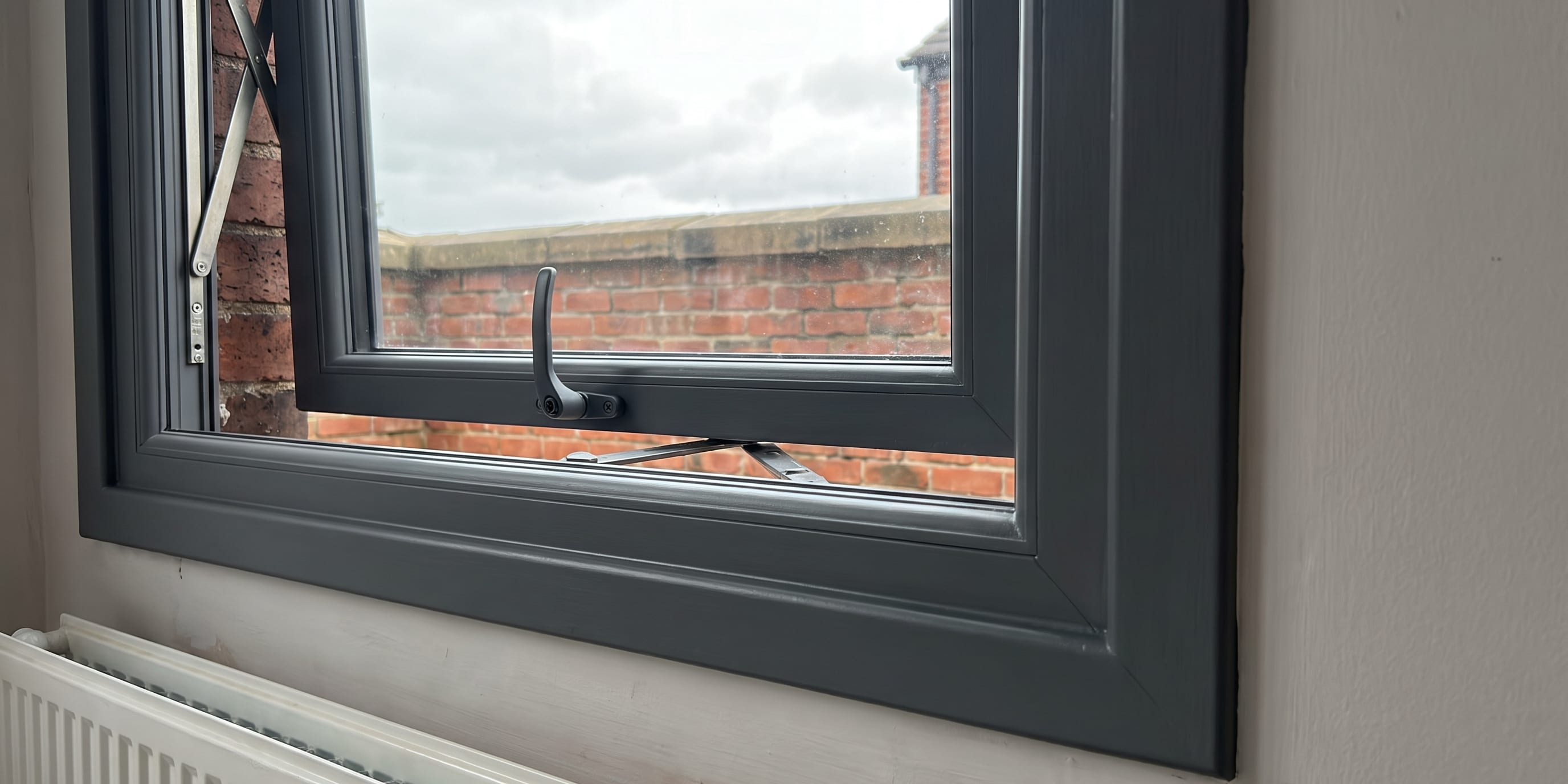
Opening windows and doors are where the craft shows. A fixed pane is a flat surface. A casement window has a sash that closes into a frame, with rebates, edges, drainage slots, gaskets, hinges and a lock mechanism, all of which have to end up coated where they should be and clear where they should not. Coating that stops short of the sash edge leaves a white line visible every time the window opens. Coating that runs into the rebate and over the gasket ends up compressed against the seal, and the first time the window is shut hard it pulls away. Overspray in a hinge or a keep stiffens the action and eventually chips.
Doing this properly takes masking discipline, handling of ironmongery, and knowing how far into each rebate the coating can safely carry. It is slow, and it is the first thing sacrificed when someone has quoted a whole house for a day and a half.
Realistic lifespan and what a guarantee should promise
A well prepared frame sprayed with a professional two-pack system should stay bonded and looking presentable for many years, not seasons. Exposure drives the variation more than anything else. South and west facing elevations take the most UV and the most driving rain, so they will show change first. Coastal properties deal with salt. A north facing rear elevation under a canopy may look virtually unchanged long after the front has softened in tone.
Colour choice matters as well. Deep colours, particularly blacks, anthracites and strong reds, hold more heat and carry more pigment load, so any fade is more noticeable than on a light grey or off white. That is not a reason to avoid them, just a reason to expect the front and back of a house to age slightly differently.
On guarantees, be clear about what is being warranted. A meaningful guarantee covers adhesion and coating integrity: peeling, flaking and delamination, which are workmanship and system failures. What no honest guarantee can promise is that a dark colour on a south elevation will be dead identical in tone a decade from now, or that the finish is immune to impact damage, ladders, strimmer strikes or aggressive cleaning products. Treat a guarantee that promises no fade whatsoever with suspicion, and ask whether it is backed by anything more than a line on the quote. Also ask what happens to the guarantee if you clean the frames with something abrasive, because that condition is usually in there somewhere.
Spotting a rushed job from a proper one
Most of the horror stories online are describing bad workmanship, not a bad process. The signs are usually visible from the pavement.
Look at the edges. Crisp, straight lines where frame meets glass and frame meets brick are the mark of careful masking. Wavy lines, paint on the glass, or fuzzy margins where overspray has crept under tape all point to speed. Then open a window. If the inside face of the sash and the rebate are still the original colour, only the parts that showed were sprayed. Run a hand over a sill: a rushed job feels gritty from dry overspray landing on a surface that was already curing, while a good one feels smooth and even.
Check the awkward places. Trickle vents, drainage slots, hinge plates and the underside of sills are where corners get cut. Look for runs and sags in the coating on vertical sections, which suggest too much material applied too fast. Look for overspray on brick, glass, guttering, driveways and neighbouring cars, because containment is part of the job.
And look at the colour depth. A properly built film has an even, uniform density. Patchy coverage where the old colour ghosts through means not enough coats, and a thin film is a film that will not last.
When spraying is not the right answer
Being straight about this is more useful than selling every job. Spraying is a finish. It changes colour and restores appearance. It does not restore structure.
If the plastic itself has perished, spraying is the wrong call. Badly degraded uPVC goes chalky and porous, and in severe cases the surface crumbles slightly when rubbed. Coating over that gives you a good looking film sitting on a substrate that is still breaking down underneath. Warped or bowed sashes, frames that have dropped and no longer close, cracked welds at the corners and splits around fixings are all structural problems. So are blown double glazed units with condensation between the panes, and rotten or water damaged timber sub-frames behind the plastic. None of those are improved by paint, and some become harder to assess afterwards.
There are also practical exclusions. Frames with heavy previous coatings of unknown type need care, because a new system is only as sound as what it sits on. Sprayed finishes also need weather and temperature within workable limits to cure properly, which in the UK narrows the sensible window at either end of the year.
A reputable sprayer should tell you when frames are past the point where a coating is the answer. If nobody has looked closely at the condition of your plastic before quoting, that is worth noting.
The trade-off against full replacement
Replacement wins on one thing decisively: it addresses everything at once. New frames, new units, new hardware, current thermal performance and a fresh service life measured in decades. If your windows are failing rather than looking tired, that is the correct spend.
Spraying wins on cost, on disruption and on options. It is a fraction of the price of new frames, there is no scaffolding out of the house and no rooms full of dust, and the colour range is not limited to whatever the window manufacturer offers as a standard foil. Sound frames with good glazing and working mechanisms that simply look dated do not need throwing away, and a colour change can shift the whole character of a facade in a way new white uPVC would not.
The honest comparison is this: replacement buys a longer interval before you think about it again. Spraying buys a much cheaper transformation that will, eventually, need refreshing. Refreshing a sprayed finish is far less involved than the original job, because the substrate is already sound and primed. For most people with functional windows and a dated colour, the arithmetic favours spraying comfortably.
So, is uPVC spraying any good? It is good when it is done as a system by someone who treats preparation as the job rather than the preamble. The finish is durable, the colour range is wide, and the frames you already own keep doing their work. Where it goes wrong is almost never the concept and almost always the corner that was cut.
If you want to know whether your frames are sound candidates and what a properly specified job involves, start with Chameleon’s uPVC window and door spraying and get the condition of your plastic assessed before you spend anything on replacements you may not need.
Questions
Frequently Asked Questions
Does paint really stick to uPVC?
Yes, provided the right system is used. uPVC is sprayed with an adhesion primer designed to bite into the plastic, followed by a compatible topcoat. Ordinary household paint straight onto a frame will fail, which is where the myth comes from.
How long does sprayed uPVC last?
A properly prepared frame sprayed with a professional two-pack system should hold its colour and adhesion for many years. Exposure matters: south and west facing elevations weather fastest, and darker colours show fade sooner than light greys and whites.
Can you spray uPVC windows that still open and close?
Yes. Opening frames need more care than fixed ones because coating has to carry round the edges and rebates without fouling the seals or hinges. That handling is one of the biggest differences between a job that lasts and one that chips within months.
Is spraying uPVC cheaper than replacing the windows?
Spraying is normally a fraction of the cost of new frames, and it changes the colour without touching the glass or hardware. It does not fix failed units, perished plastic or warped sashes, so it is a finish upgrade rather than a repair.
Will sprayed uPVC peel?
Not if the preparation and primer are right. Peeling is almost always a prep failure: contamination left on the surface, a skipped adhesion primer, or coating applied over chalky, degraded plastic that was never sound to begin with.