Chameleon
Is Your Kitchen a Good Candidate for a Cabinet Respray?
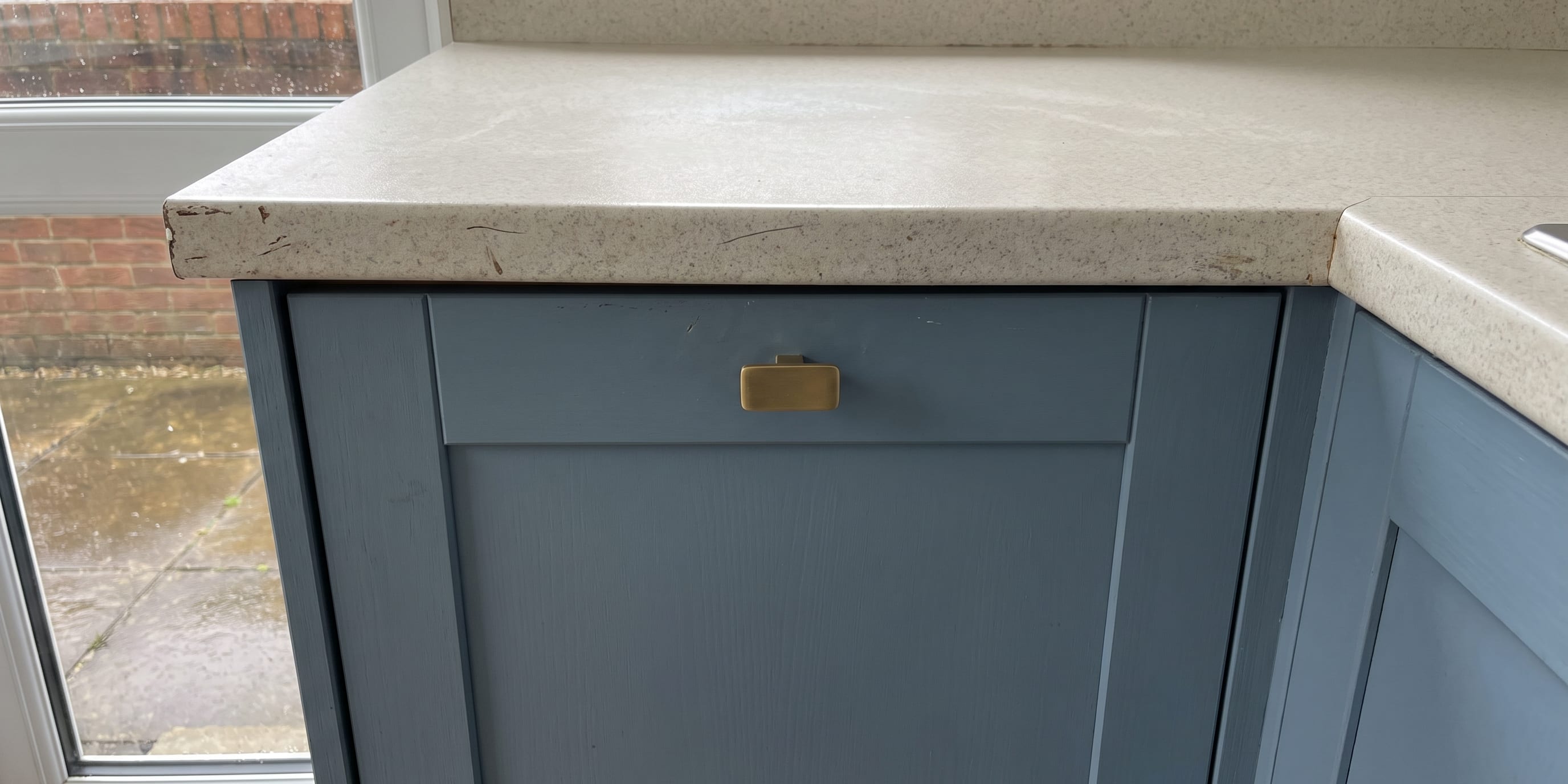
Most people researching a kitchen cabinet respray have already decided they like the idea. Keeping the carcasses, the worktops and the layout while changing the colour is obviously appealing. What they actually want to know, before they commit, is narrower and more practical: will my particular kitchen take the paint properly, and will the finish still look good in a few years' time?
Those are fair questions, and they deserve a straight answer rather than a sales pitch. Some kitchens are excellent candidates. A few genuinely are not, and no amount of preparation will change that. This article walks through the materials, the warning signs, the realistic durability picture and what the finish is actually like to live with.
Will my cabinet material take the paint?
Almost every kitchen is built from one of a handful of door constructions. The construction, not the brand or the age, determines how straightforward the work will be.
Solid wood and timber-framed doors
Solid timber is one of the most forgiving materials to spray. It takes primer readily, it can be filled and sanded where there are dents, and damaged edges can be made good rather than written off. Shaker frames, raised and fielded panels and traditional in-frame kitchens all respray well.
The one characteristic to be aware of is grain. Oak in particular has an open, textured grain that remains visible through paint unless it is deliberately filled, and even then some texture tends to telegraph through. For many people that is part of the appeal: a painted oak kitchen that still reads as timber. If you are expecting the dead-flat, grainless look of a modern slab door, open-grain timber will not give you that, and it is better to know in advance than to be disappointed afterwards.
Painted or primed MDF
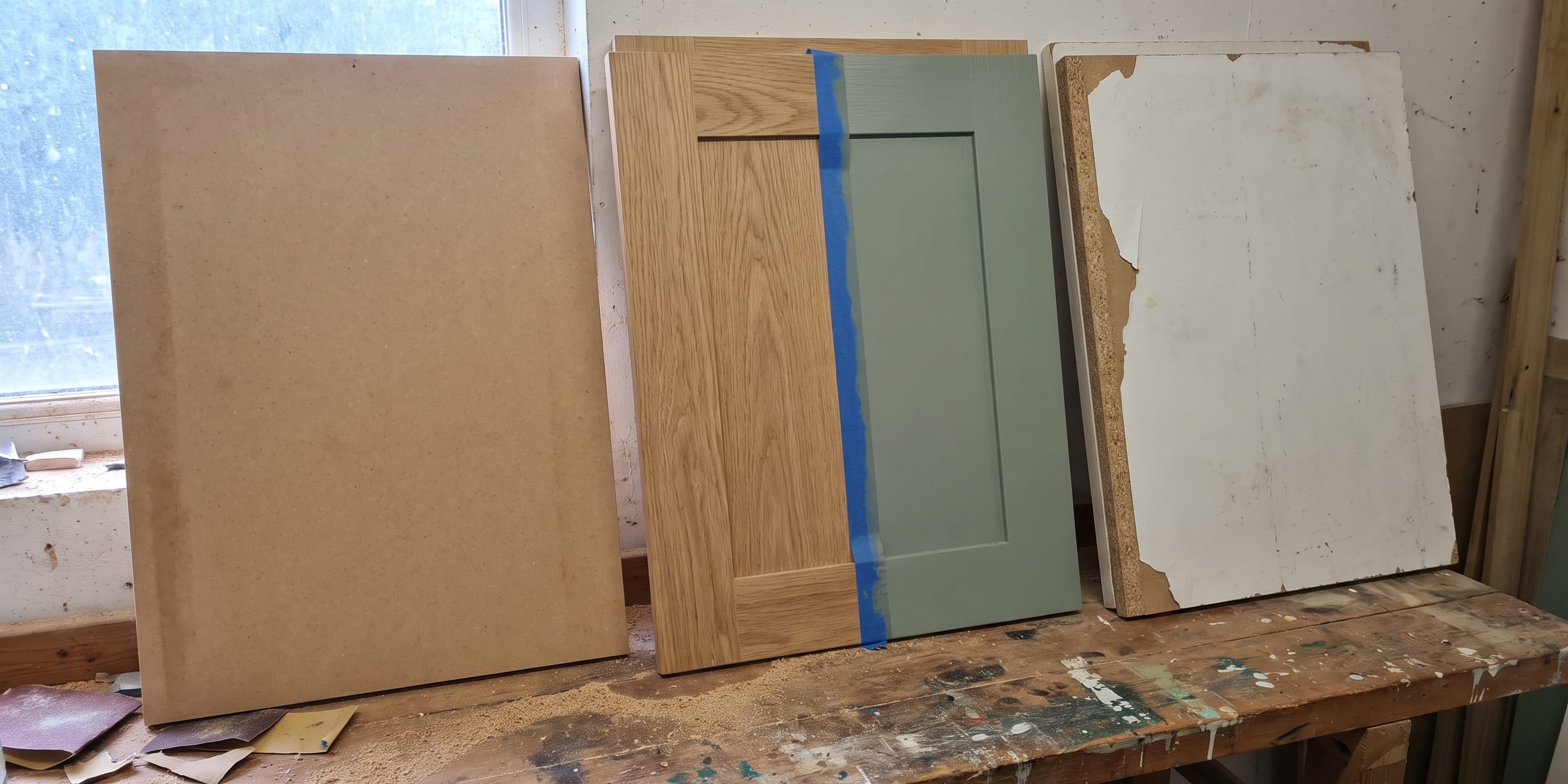
Painted MDF is the ideal candidate. It is stable, dimensionally consistent, free of grain and manufactured to be coated in the first place. Most factory-painted Shaker kitchens sold in the UK over the past couple of decades fall into this category, and they respray beautifully: abrade the existing finish, address any chips, prime and apply the topcoat.
The only real variable is the condition of the existing paint. Flaking or poorly adhered factory coatings must be dealt with rather than sprayed over, because a new coating is only ever as sound as the layer underneath it.
Foil-wrapped and vinyl-wrapped doors
This is the category that generates the most uncertainty, and the honest answer is that it depends entirely on the condition of the wrap.
A vinyl-wrapped door is an MDF blank with a thin thermoformed film bonded over it. Where that film is still firmly adhered across the whole face and around every edge, it can be abraded, primed with an appropriate adhesion primer and coated successfully. The result looks no different from a sprayed MDF door.
Where the film has started to let go, the picture changes. Lifting around the edges, bubbling near the oven or kettle, or a corner you can catch with a fingernail all mean the bond has failed. Spraying over a failing wrap simply paints the problem a different colour, and the lifted area will continue to lift. Those doors need the wrap removing and the substrate making good, or replacing outright.
Melamine and laminate faced doors
Melamine-faced chipboard and laminate doors are smooth, low-porosity and non-absorbent, which is exactly why they need a specialist primer rather than a general-purpose one. Adhesion is the entire battleground here. With the correct system they coat well and look excellent, because the surface is already flat and uniform. With the wrong primer, the finish will chip at the edges within months.
The same logic applies to the carcasses, end panels and plinths, which are very often melamine even in kitchens with timber doors. A respray that treats the doors properly but skips the right preparation on the visible cabinet sides is a half-finished job.
Physical signs your kitchen is a poor candidate
There are a small number of conditions that mean a respray is the wrong recommendation, and a reputable sprayer will tell you so.
Swollen MDF. Water gets into unsealed board edges, most commonly along the bottom of the door beneath the sink, beside the dishwasher or under a leaking tap. The board expands and the surface develops a soft, lumpy, almost spongy profile. This is irreversible. Paint cannot compress swollen fibreboard back into shape, and a coating applied over it will highlight the distortion rather than hide it. The door needs replacing.
Delamination. Where a laminate or melamine face is parting from the board beneath, or where a veneer is bubbling away from its substrate, the bond has failed. Anything sprayed on top inherits that failure.
Peeling foil edges. As above, lifted vinyl is not a cosmetic issue. It is a sign that the adhesive has given up, usually through sustained heat. Doors next to ovens and dishwashers go first.
Sustained moisture damage. Soft carcass bases, musty smells inside cabinets, rust on hinges and runners, or black marking around the sink unit all point to a water problem that must be fixed before any decorative work is considered.
Doors that are structurally tired. Sagging hinges can be replaced cheaply, but doors with split joints, missing chunks of edge or broken panels are better swapped out. Replacement doors can be sprayed alongside the originals in the same colour, which is usually far cheaper than a new kitchen and keeps everything matching.
How long the finish actually lasts
The useful answer is not a single number, because the same coating on two different kitchens will not behave the same way. What determines lifespan is this:
Preparation. Degreasing, abrading and priming correctly accounts for most of the durability of the finished job. Kitchen doors carry a surprising amount of cooking grease, particularly above and around the hob, and any contamination left behind becomes a future adhesion failure.
Coating specification. Products designed for high-wear joinery and cabinetry are formulated to resist knocks, handling and cleaning in a way that standard trade emulsion or ordinary eggshell simply is not. Coating choice is one of the clearest differences between a professional respray and a brush-painted DIY attempt.
Curing time. Coatings reach a touch-dry state quickly but continue hardening for a period afterwards. Treating the kitchen gently during that window has a disproportionate effect on how it performs for years afterwards.
Daily use. A quiet household with good extraction and dry hands around the handles will get a longer life than a busy family kitchen where doors are opened with wet fingers and the hob runs twice a day. Neither is wrong, but they are different realities.
The areas that show wear first are predictable: the edges around the most used handles, the door beside the bin, the cupboard above the kettle where steam collects, and the base unit by the dishwasher. Targeted touch-up of those specific areas is far more realistic than redoing a whole kitchen, which is a genuine advantage of a sprayed finish over a replacement one.
What it looks and feels like day to day
Here is the honest comparison with a factory-new kitchen.
A sprayed finish is smooth and even, with no brush marks, roller texture or visible laps. Run your hand across a door and it feels consistent rather than ridged. In satin and matt sheens in particular, it is difficult to distinguish from a factory-painted door at normal viewing distance.
What a respray does not do is change the kitchen’s bones. The door profiles stay as they were. Edge detail stays as it was. Minor historic dings that were filled will usually be invisible, but the overall character of the doors remains the character you already own, in a new colour. If you dislike your door style, a respray will not solve that.
Very high gloss is the least forgiving sheen, because gloss amplifies every imperfection in the surface beneath it. On a flat, sound, modern slab door it can look superb. On older doors with a lot of history, a satin or matt finish is usually the more flattering choice.
Day to day, the finish behaves like good painted joinery. It wipes clean, it tolerates normal family use and it will mark if you drag a cast iron pan across it. That is not a defect; it is what any painted surface in a working kitchen does.
Looking after the new finish
Aftercare is simple and it matters more than most people expect.
In the early weeks, while the coating is still hardening, use nothing more than a soft cloth and warm water. Avoid cleaning sprays entirely during this period, and be gentle around handles and edges.
Once fully cured, the rules stay sensible rather than fussy:
- Wipe spills promptly, especially anything acidic such as lemon juice, vinegar or wine.
- Use a soft cloth or sponge, never a scouring pad, wire wool or a melamine eraser block.
- Avoid bleach-based cleaners, oven cleaner, solvent degreasers and anything labelled as abrasive.
- Do not let water sit along the bottom edges of doors, particularly near the sink and dishwasher.
- Keep the extractor running during and after cooking, and open the dishwasher carefully so steam is not funnelled straight onto the adjacent cabinet fronts.
- Fit soft-close dampers or door buffers if you do not already have them, to stop repeated impact on the same points.
None of this is onerous. It is roughly how you would treat any quality painted surface.
Making the decision
If your kitchen has sound doors, a stable surface and a layout you are happy with, a respray is very likely a sensible option. If you have swollen board, lifting foil or an underlying water problem, deal with those first, or replace the affected doors and spray them in with the rest.
Once you know your kitchen is suitable, the next question is usually budget, and we have covered that separately in our guide to kitchen respray cost, which sets out what drives the figure up or down.
If you would like an informed opinion on your specific doors rather than a general one, the simplest next step is a survey, where the materials, condition and problem areas can be assessed properly before anything is quoted. You can find out more about Chameleon’s kitchen respraying service and what the process involves from start to finish.
Questions
Frequently Asked Questions
Can foil-wrapped or vinyl-wrapped kitchen doors be resprayed?
Often yes, provided the wrap is still firmly bonded to the door. The foil is spray-coated rather than stripped, so the condition of the existing wrap matters enormously. Where edges or corners have lifted, bubbled or peeled away from the MDF beneath, those doors need repair or replacement before any coating is applied.
How long does a sprayed kitchen finish last?
A properly prepared and correctly specified finish should be measured in years, not months. Lifespan depends far more on preparation quality, the coating system chosen and daily use than on the colour or sheen. Kitchens with good extraction, sensible cleaning habits and no standing water at the sink and kettle areas hold up longest.
Will a resprayed kitchen look exactly like a brand new one?
It will look like a freshly finished kitchen rather than a brand new one. Spraying delivers a smooth, even, hand-free finish, but the underlying doors keep their existing profile, thickness and any historic knocks that were not filled out. Close up, door edges and panel detail still read as the kitchen you already own.
What is the worst thing I can do to a newly sprayed kitchen?
Clean it too soon with the wrong product. Coatings continue to harden for a period after spraying, and aggressive cleaners, abrasive pads or bleach-based sprays used during that window can dull or mark the surface permanently. Warm water and a soft cloth are all that is needed early on.
Can damaged MDF doors be resprayed?
Not if the board has swollen. Water ingress causes MDF to expand irreversibly, usually along bottom edges near a dishwasher or sink. Paint will not shrink the board back down, so swollen doors should be replaced and sprayed to match the rest of the kitchen.