Chameleon
Kitchen Respray Cost: What Actually Decides the Price
Ask three companies what a kitchen respray costs and you will get three different answers, sometimes wildly different. That is not necessarily a sign that two of them are trying it on. Kitchen respraying is priced on variables that are invisible in a photograph and absent from a floor plan, and until someone has counted your doors and looked at what they are made of, any figure is invention.
This page does not give you a number. It gives you the things that decide the number, so that when quotes land you can tell which one is fair, which one is high, and which one is cheap because it has quietly left something out.
Door and drawer count, not floor area
The most common mistake in estimating a kitchen respray cost is thinking in square metres of kitchen. Two kitchens in identically sized rooms can differ by a third or more in price, and the reason is the number of separate pieces that have to be handled.
Every door and every drawer front is an individual unit. It has to be degreased, abraded, dusted off, wiped down, masked or hung, sprayed on the face, sprayed on the edges, and left to cure without touching anything. That sequence takes roughly the same time whether the door is 300mm wide or 600mm wide. So a kitchen with twenty narrow drawer fronts is a substantially bigger job than a kitchen with the same run length made up of large cupboard doors.
The same logic applies to everything else that gets sprayed. Open shelving, plinths, cornice, pelmet, end panels, larder interiors, glazed door frames and island returns all add units. Glazed doors add time in particular: the glass has to be masked precisely and the framing sprayed without overspray on the pane.
It is also why a straight run along one wall is cheaper per metre than a galley or a U-shape. More corners mean more end panels, more awkward access and more surfaces the gun has to be worked at an angle. When you compare quotes, check whether each one has counted the same number of items. If one lists thirty-two doors and drawer fronts and another lists twenty-six, they are not quoting for the same job.
What your kitchen is made of, and what state it is in
The second big variable is what you are spraying onto. Preparation is the bulk of the labour on a kitchen respray, and different substrates demand different amounts of it.
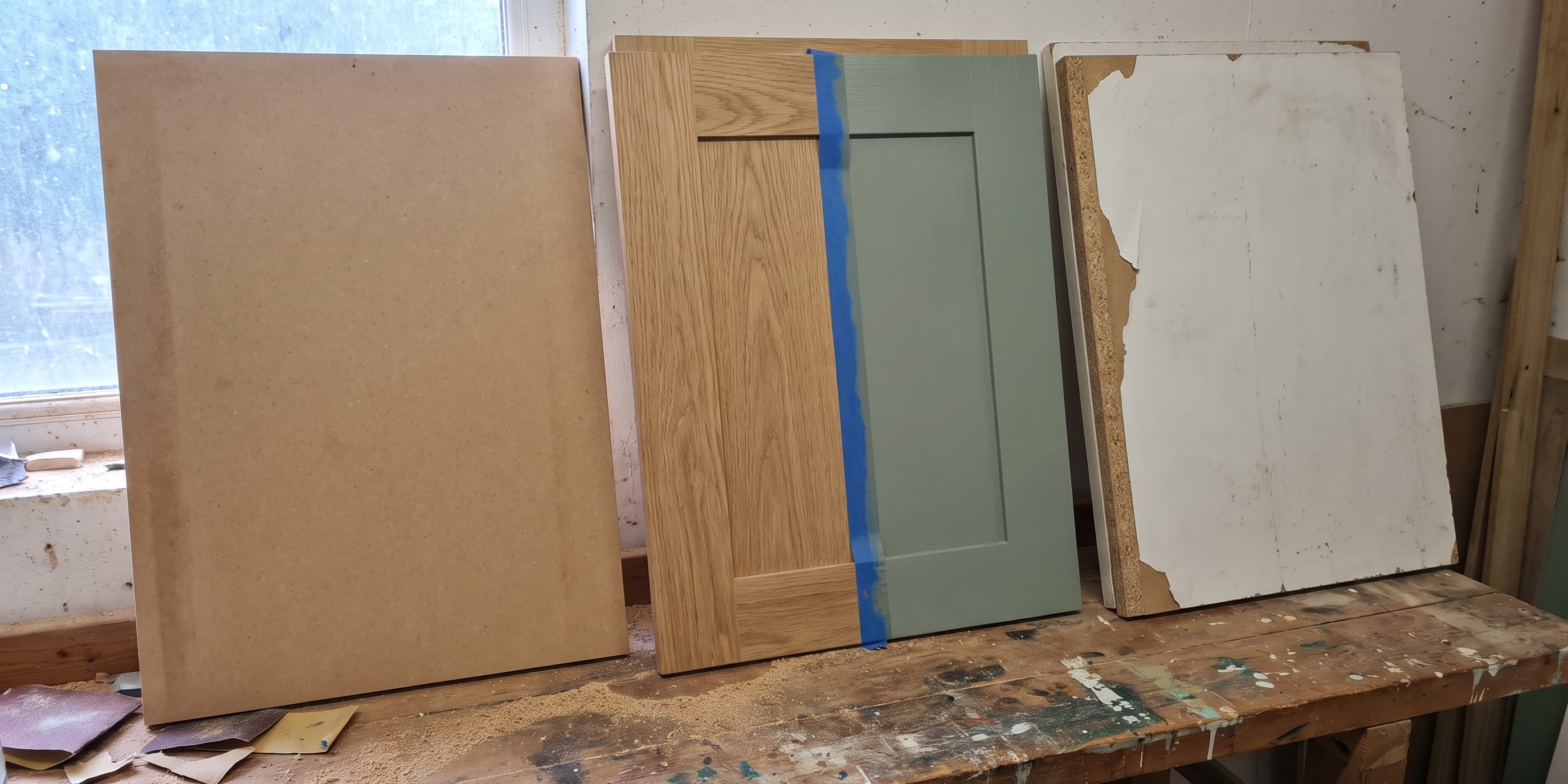
Laminate and melamine faced doors are common and perfectly sprayable, but they are non-porous and designed to resist things sticking to them. They need thorough degreasing, careful abrasion to create a key across the whole face and every edge, and an adhesion primer suited to the surface. Skip any of that and the finish will not bond properly, however good the topcoat is.
Vinyl wrapped doors are the ones that most often catch people out. The wrap is a thin film heat-bonded to an MDF core, and around ovens, kettles and dishwashers it commonly starts lifting or bubbling at the edges. Lifted wrap cannot simply be sprayed over. It has to be dealt with, either by removing and filling back or by treating the affected areas, and that is real additional labour. Two vinyl kitchens of the same size can differ significantly in price purely because one has peeling corners and the other does not.
Solid timber and timber framed doors may need the grain filling if you want a flat, contemporary finish rather than a grained one. Previously stained or waxed surfaces need the contamination removing before anything will sit on top of them, and the shadow lines and rebates around panels need proper attention rather than a quick pass.
Previously painted doors are the hardest to price without seeing them. If the existing coating is sound and well adhered, it can often be keyed and overcoated. If it is chipping, peeling or was applied without proper preparation the first time round, it has to come back, and that can become the biggest single labour item in the project.
Then there is damage: swollen bottom edges beside the dishwasher, water damage under the sink, chipped corners, and old handle holes needing filling because you are changing handle pattern. None of it is exotic, but all of it is time, and a quote that has looked properly at your kitchen will reflect it.
In situ or collected and returned
There are two broad ways to spray a kitchen, and the choice changes both the price and your week.
Workshop spraying means the doors and drawer fronts are removed, taken away, sprayed in a controlled environment and brought back for refitting. Dust control is better, temperature and airflow are managed, doors can be sprayed flat or hung properly, and there is no aerosolised paint anywhere near your home. The costs are transport, handling and the labour of removal and refitting, plus the fact that carcasses, end panels and fixed framework still have to be dealt with on site.
In-situ spraying means everything is done in your kitchen. It removes the transport and refitting labour, and doors and carcasses are sprayed in the same conditions with the same batch of material, which helps consistency. What it adds is containment: comprehensive masking of worktops, appliances, floors, walls, ceilings, sockets and doorways, plus extraction to control overspray. That masking is not a five minute job, and it is the part cheap operators skip.
Neither approach is inherently cheaper. What matters is that the quote states which one is being used and prices the associated work honestly. If a quote proposes in-situ spraying and makes no mention of masking or containment, ask about it. Weigh disruption too: in-situ work puts your kitchen out of use for the duration, whereas a workshop approach can sometimes leave the carcasses usable while the doors are away. If you are trying to work out which applies to your own kitchen, whether the doors actually have to come off is worth reading before you commit to either.
Single colour, two-tone, and the cost of changing colour
Colour is not a free choice. It has a labour consequence.
A single colour throughout is the most efficient option: one material, one setup, one run through the whole kitchen. Two-tone kitchens, typically darker bases with lighter walls, or an island in a contrast colour, mean two separate spraying operations. Equipment has to be flushed and cleaned between colours, elements have to be separated and scheduled so nothing is contaminated, and any junction where the two colours meet needs masking to a clean line. On a small kitchen that is not an enormous difference, but it is a real one.
Changing colour at all costs more than refreshing the existing one, even in a single tone. Opacity is the reason. Going pale over a dark existing finish, or using a colour with poor natural coverage, may need an extra coat to reach the point where the underlying colour is genuinely gone rather than nearly gone. That extra coat is not just material, it is another full pass over every unit plus the drying time in between.
Why the paint system matters more than the paint colour
Kitchen doors take more abuse than any other painted surface in a house. Fingernails, handles, rings, cleaning products, splashed cooking oil, kettle steam, dishwasher vapour, spilled wine. A finish that would be perfectly adequate on a hallway wall will not survive that.
A properly specified kitchen respray uses a two-pack system, commonly called 2K. These are catalysed coatings: a hardener is mixed into the material and a chemical reaction cures the film, rather than it simply drying by evaporation. The result is a considerably tougher, more chemically resistant surface that stands up to daily wiping and knocks around handles. Applied through professional spray equipment onto properly prepared substrate, it gives a smooth, uniform finish with no brush marks and no roller texture.
What that competes against at the cheap end is one of two things. Aerosol cans, which cannot deliver consistent film build or durability and show their limitations quickly in high-contact areas. Or a standard trade paint brushed and rolled on, which looks acceptable for a while, then chips at edges and corners because it was never formulated for the job.
This is why the cheapest quote so often turns out not to be the cheapest option. The saving nearly always comes from the same handful of places: less degreasing, less abrasion, no adhesion primer, fewer coats, cheaper material, and no allowance for repairing damage that was already there. You see none of it on handover day. You see it a year or so later around the handles, on the door beside the dishwasher and at the bottom edge of the cupboard under the sink. At that point the real cost is the original price plus the cost of doing it properly.
What a good quote itemises
You cannot compare two quotes fairly if they describe the work in different amounts of detail. A quote worth trusting lets you see the job, not just the total. Look for:
- A count. Doors, drawer fronts, end panels, plinths, cornice and any shelving or glazed units included.
- What happens to the carcasses. Are the internal boxes and visible frames being sprayed, or only the doors? That is a significant difference in scope.
- Preparation described as a sequence. Degreasing, abrasion, filling and repair, priming. The word "prep" on its own tells you nothing.
- The coating system and number of coats. Product type, primer, topcoat, how many passes.
- Colour and sheen. The specific colour reference and the sheen level, matt through to gloss.
- In situ or workshop. Stated explicitly, with masking and containment mentioned if it is in situ.
- Timescale and access. How many days, and when your kitchen is unusable.
- Exclusions. Handles, hinges, worktops, splashbacks, appliance repositioning, replacement doors for units beyond repair. What is left out matters as much as what is included.
Why one quote comes in higher than another
With that detail in front of you, the differences usually explain themselves. A higher quote generally reflects one or more of the following: a higher item count because the contractor counted the drawer fronts and end panels properly; more preparation because they noticed the lifting vinyl or the water damage; a full carcass respray where the other covers doors only; a two-pack system where the other uses something cheaper; an extra coat allowed for a difficult colour change; or a realistic allowance for masking and protecting your home.
A lower quote is either a leaner operation with genuinely lower overheads, which does happen, or it is smaller in scope. The way to tell is to put the two documents side by side and find the line where they diverge. If you cannot find it, the cheaper quote probably does not contain enough information, and that in itself is your answer.
Nobody can tell you your kitchen respray cost without looking at your kitchen. What you can do is arrive at that conversation knowing which questions decide the figure, so the quote you accept is the one that actually covers the work.
Or see the full kitchen respraying service first, if you’d rather read before you book.
Questions
Frequently Asked Questions
Why won’t you publish a starting price for a kitchen respray?
Because a headline figure would be meaningless without knowing your door and drawer count, the material they are made from, their condition, whether the work is done in your home or in a workshop, and whether you are changing colour. A number quoted before any of that is known is a guess, and a guess is not much use when you are comparing real quotes.
Is spraying a kitchen in situ cheaper than a workshop respray?
Not automatically. In-situ work saves the labour of removing, transporting and refitting doors, but it adds significant masking and containment time in your home. Workshop spraying gives a more controlled environment for the doors but usually still needs on-site work for the fixed elements. The right choice depends on your kitchen and your tolerance for disruption, not on price alone.
Does changing colour cost more than respraying in the same colour?
Usually yes. A colour change often needs extra coats to achieve full, even opacity, and the difference is larger when you are going light over dark or using a colour with weak natural coverage. Every edge, return and inner face has to be reached properly too, because a half-covered edge is obvious the moment a door is opened.
Why is the cheapest kitchen respray quote often the most expensive in the end?
Because the saving usually comes from somewhere: less degreasing and abrasion, fewer coats, a brush or roller trade paint instead of a sprayed two-pack system, or no allowance for repairing damaged edges. Those shortcuts show up as chipping around handles, peeling on wet edges near the sink, and a finish that has to be redone far sooner than it should.
What should a kitchen respray quote actually list?
The number of doors, drawer fronts and panels included, what happens to the carcasses and end panels, the preparation described in steps rather than as one word, the coating system and number of coats, whether it is in situ or collect and return, the colour and sheen level, and a clear list of exclusions such as handles, worktops, hinge replacement or repairs to damaged substrate.