Chameleon
Should You Respray Kitchen Cupboards? An Honest Answer
Here is the straight version, before anything else. Respraying kitchen cupboards is an excellent idea when the kitchen is structurally sound and you simply dislike how it looks. It is a poor idea when the kitchen is physically failing and you are hoping a coating will hold it together. Most of the disappointment people report with sprayed kitchens comes from that second category, not from the process itself.
The trouble is that almost everything written about kitchen respraying is written by someone who wants to spray your kitchen. So the honest part, the bit where someone tells you your doors are not a good candidate, tends to go missing. This article is an attempt to fill that gap: what takes a spray finish well, what does not, what a respray cannot repair, how long the result realistically lasts, and how to tell a durable job from a cheap one before you have paid for it.
A respray is not painting
Brush and roller leave a relatively thick, soft film with texture in it. Spraying atomises the coating into fine droplets that land and flow together into a continuous film with no brush marks, no stipple and no visible edges. On a shaker door, where the coating has to run into and out of the profile without pooling in the corners, the difference is unmistakable.
The other half of the difference is chemistry. A professional respray uses catalysed coatings, typically two pack systems where a hardener triggers a chemical cure rather than simply drying by evaporation. That cured film is what resists fingernails, cleaning products, steam and a door being opened a dozen times a morning. A decorator’s eggshell will not, however neatly it goes on.
So the real question has two halves. Can the surface accept and hold a catalysed coating? And is the kitchen underneath worth putting one on?
Which cupboard materials take a respray well
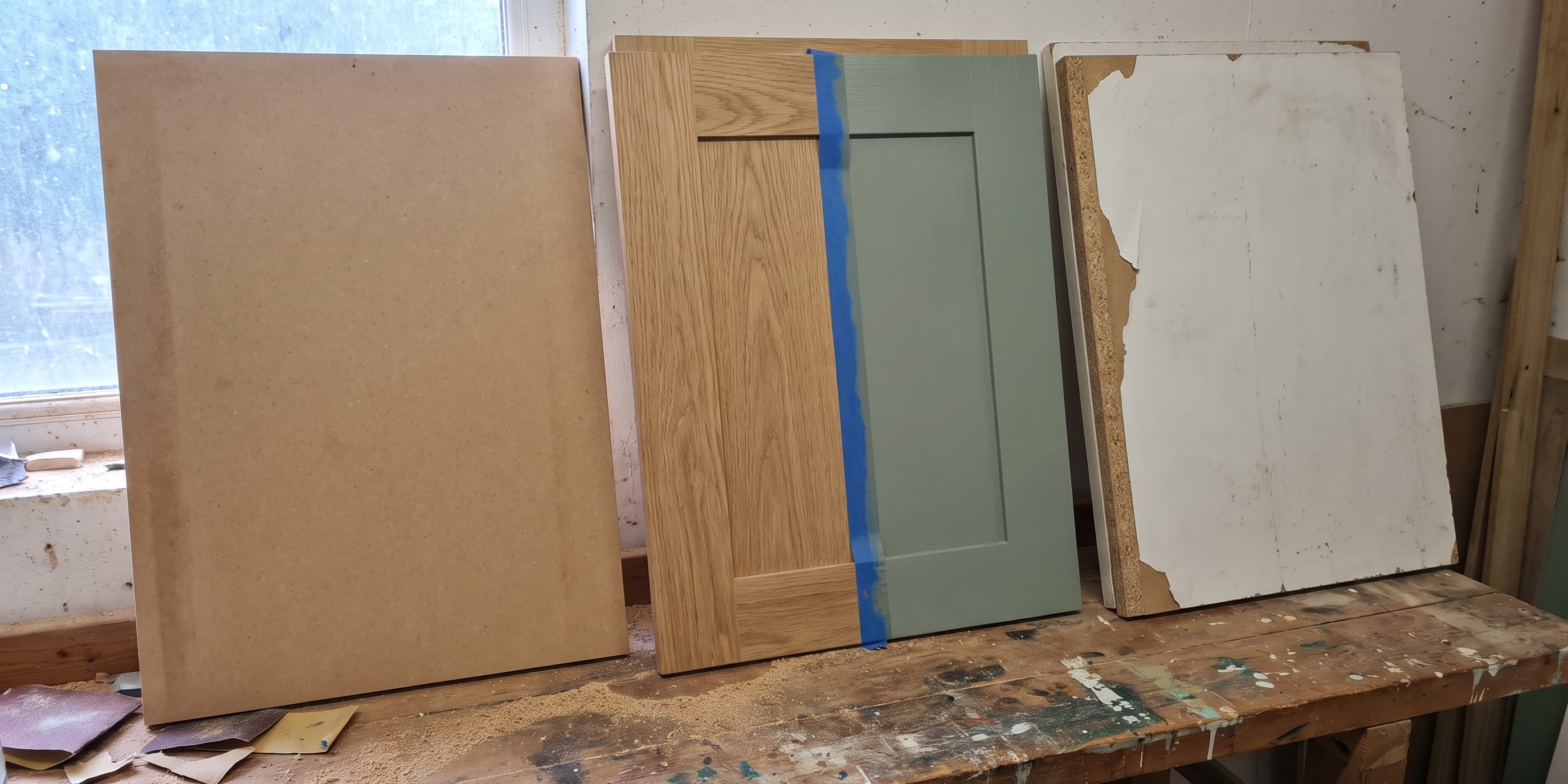
Solid wood and timber framed doors. Generally the best candidates there are. Wood can be sanded back, keyed, filled and sealed, and it accepts primer readily. Tired oak or pine with a dated honey stain can be transformed completely. One caveat: open grained timbers such as oak will show their grain through an opaque finish unless a grain filler is used. That is not a fault, and some people want it, but if you expect a flat, factory smooth slab from an oak door, say so up front so the right preparation is specified.
Painted and primed MDF. Shaker doors from most UK kitchen suppliers are MDF with a sprayed factory finish, so they respray beautifully. The existing coating can be degreased, abraded to a key and recoated with a system that bonds to it. Colour changes in either direction, light to dark or dark to light, are straightforward with the right number of coats.
Melamine and laminate faced chipboard. Very common in kitchens fitted from the nineteen nineties onwards, and often the ones people most want to change. These can be sprayed successfully, but they are unforgiving of poor preparation. Melamine is deliberately non porous, so nothing soaks in. Adhesion depends entirely on thorough degreasing, a proper mechanical key and a bonding primer designed for the surface. Done properly the result is durable. Skipped, the coating peels off in sheets within a year.
Vinyl wrapped MDF. The most situational of the lot. A thermoformed vinyl wrap sits over a shaped MDF core, and if that wrap is still fully bonded everywhere the doors can be prepared and sprayed. It usually lifts first beside the oven, above the kettle or at the top edge of a dishwasher, and where it has lifted you have a substrate problem rather than a colour problem. Spraying over a lifting wrap traps the fault under the new finish and it will reappear.
High gloss and veneered doors. Both are sprayable where the surface is intact. Matching a mirror gloss factory panel takes a skilled hand and the right environment, so a satin or matt respray over gloss is far more predictable than attempting gloss on gloss. With veneer, the same rule applies as with vinyl: fine if it is bonded, hopeless if it has blistered.
Steel splashbacks, cooker hoods and metal frames spray well. Glazed doors are masked. Handles are normally removed, and whether they are sprayed, replaced or left alone is worth deciding deliberately, because old brassy handles will undermine an otherwise excellent new colour.
What respraying cannot fix
This is the section the vendor pages leave out, and it is the one that saves people money.
Structural failure. If carcasses are sagging, if shelves are bowed under the weight of crockery, if doors no longer hang square because the cabinet sides have moved, a coating changes none of that. Spray finishes are measured in fractions of a millimetre. They have no structural function whatsoever.
Water damage and swollen board. Chipboard and MDF that have taken on water swell irreversibly. The fibres expand and lose their bond and the surface goes soft and crumbly, classically at the base of the sink unit or under a dishwasher that has been weeping quietly for a year. You cannot seal that back into solid material. The damaged part has to come out, and the leak causing it has to be fixed, before any coating is relevant.
Delamination. Where a laminate, vinyl or veneer facing has separated from the board beneath, the new coating bonds to the loose facing, not to the door. The bond underneath is the weak link, and the new finish will fail wherever the old one has.
Blown edges and broken corners. Minor chips and dents can be filled and made invisible under a sprayed finish. A corner that has crumbled away, or an edge band that has lifted along its full length, is a repair job first. Sometimes that repair is sensible. Sometimes it is a sign that the door has had its life.
Bad layout. A respray will not move your oven, widen a walkway, give you drawers instead of a deep cupboard you cannot reach into, or fix a kitchen that annoys you every time you cook in it. If your real complaint is how the kitchen works rather than how it looks, a respray is treating the wrong problem and you will still be irritated afterwards, just in a nicer colour.
Is your kitchen a strong candidate?
A few honest tests you can carry out yourself in ten minutes.
Open and close every door and drawer. Do they run smoothly, sit square and stay shut? Hinges and soft close mechanisms can be replaced cheaply, so the mechanism is not the question. The question is whether the boxes they are mounted to are still true.
Press the board at the base of the sink unit and either side of the dishwasher. Firm under your thumb is good. Spongy is not.
Look along the door edges in raking light. Lifting laminate, bubbled vinyl or veneer edges that catch your fingernail are a warning sign. Isolated examples on one or two doors can be handled by replacing those doors. Widespread lifting across the set means the kitchen is past it.
Ask what you would change if money were no object. If the answer is colour, finish and handles, you are an excellent candidate. If it involves moving walls, relocating the sink or replacing the worktops anyway, the sums start pointing elsewhere. Bear in mind too that new cupboard colour beside a scratched laminate worktop and a yellowing oven can emphasise the old items rather than lifting them.
The clearest candidates are kitchens that were well made and are now simply the wrong colour: the solid oak fitted when honey tones were everywhere, the cream shaker that has gone slightly beige, the dark gloss that made a small room feel smaller. Nothing is wrong with them except taste, and taste is exactly what a respray changes.
The realistic lifespan of a respray finish
Be suspicious of anyone offering a precise figure, because the honest lifespan depends on the kitchen and the household using it.
What you can reasonably expect from a properly prepared, catalysed finish is years of ordinary family use rather than months, and a surface that does not need stripping and redoing on any sort of schedule. The failure mode is not usually dramatic. Coatings that are going to fail through poor preparation tend to do so early, within the first year, by peeling or flaking rather than wearing. A job that gets through its first year intact generally goes on being intact.
What does change over time is appearance in specific places. Wear concentrates exactly where you would expect: the arc around handles where fingernails land, the bin cupboard, the doors either side of the sink, the drawer front below the hob, the panel beside the back door. Those areas will look tired first, and crucially they can be touched up or resprayed individually without redoing the whole kitchen.
Three things shorten the lifespan of any sprayed kitchen more than the coating ever will. Standing moisture, especially steam from a kettle positioned under a wall unit. Aggressive cleaning, particularly bleach based sprays, cream cleaners and anything abrasive. And impact, which no coating defends against. Warm water with a little washing up liquid and a soft cloth is genuinely all a sprayed finish wants.
One more honest point. Most resprayed kitchens are eventually replaced because the owner’s taste moved on or the house changed hands, not because the coating gave up. Think of a respray as buying your kitchen a second useful lifetime, not as making it permanent.
Respray versus replacement, beyond the price
Cost is the obvious comparison and it is not the interesting one. Keeping your carcasses, worktops, appliances, plumbing and electrics means a respray is always the smaller financial commitment. Three other differences matter more.
Disruption. Replacing a kitchen means losing your kitchen. Rip out, waste removal, possible plastering and electrical work, delivery delays on units, a template wait on stone worktops, and weeks of washing up in the bath. A respray keeps the room functional. Doors come off and go away to be sprayed in controlled conditions, frames and panels are masked and sprayed in situ, and in most households the kitchen remains usable with some inconvenience rather than being out of commission.
Waste. A full strip out of a sound kitchen sends a lot of chipboard, MDF and laminate to landfill, none of which recycles well. If the carcasses are in good condition, throwing them away to change their colour is a genuinely wasteful act. That is not a marketing point, it is just true.
Time bought. This is the one to be clearest about. A respray does not have to be the last decision you ever make about the room. If you know you want a different layout in several years, or you are waiting to extend, or you are planning to sell and want the kitchen presentable rather than perfect, a respray buys you that window at a fraction of the commitment. Plenty of kitchens get sprayed specifically as an interim measure, and that is a rational use of the process rather than a compromise.
What a proper spray system should include
Prices vary for reasons, and most of the reasons live in the preparation. Here is what to look for when you compare quotes.
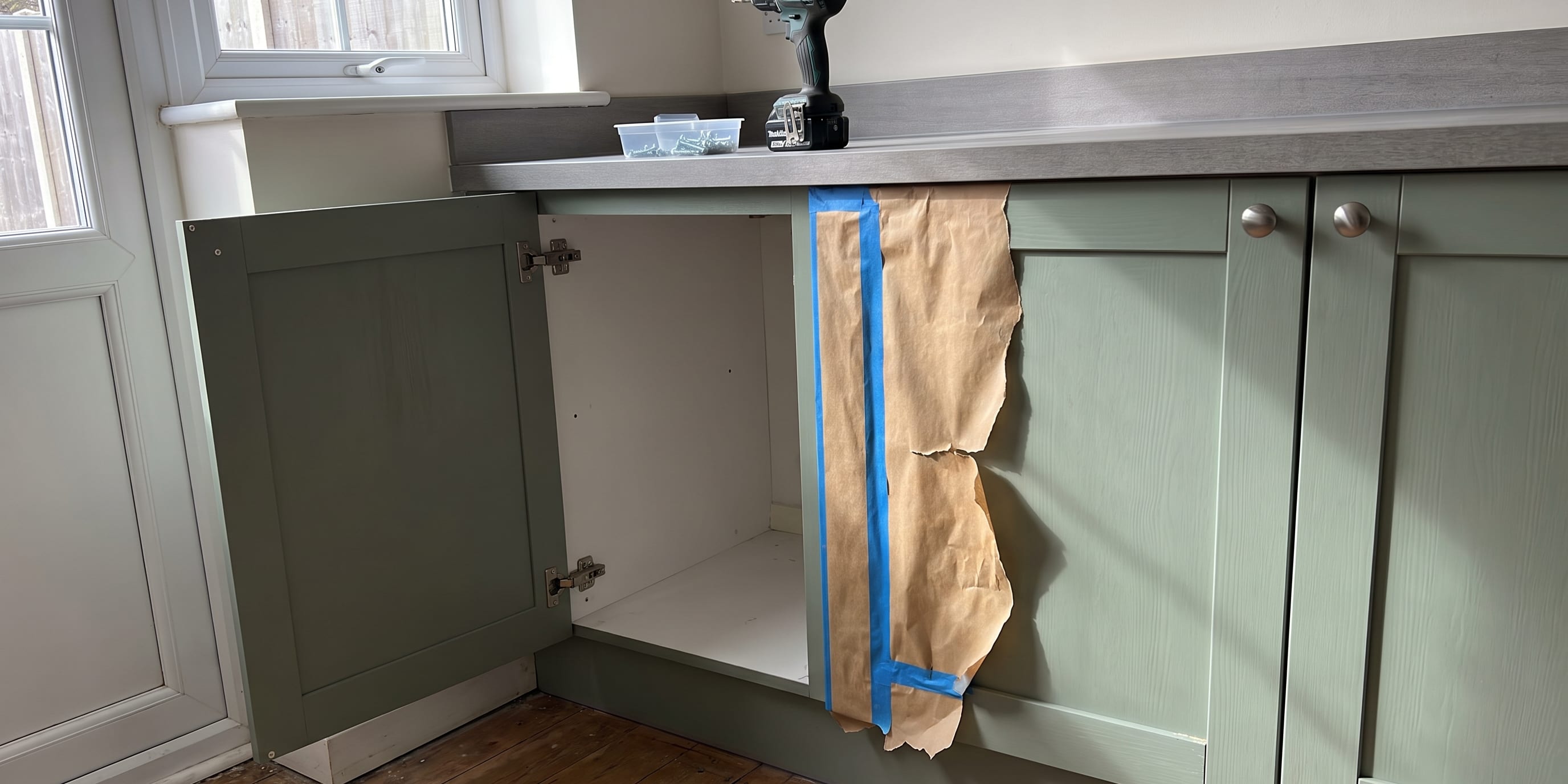
Doors removed, labelled and sprayed off site or in a controlled area. Coatings flow and level best on a horizontal surface. Doors sprayed while hanging on their hinges risk runs on the face and are almost certainly not being coated properly on their edges and backs.
Degreasing before anything else. Kitchen surfaces carry years of cooking grease, often invisibly. Sanding a greasy door simply drives the contamination into the key. Thorough cleaning with the appropriate degreaser comes first, every time.
A mechanical key. Every surface abraded so the primer has something to grip. This is slow, dull work and it is the first thing a cut price job skips.
The correct primer for the substrate. Not one primer for everything. Melamine and vinyl need bonding or adhesion promoting primers. Bare or filled MDF needs a sealing primer. Timber may need a stain blocking primer to stop tannins bleeding through a pale topcoat. If a quote does not identify which primer is going on your particular doors, ask.
Filling and denibbing between coats. Chips filled, dents made good, and the primed surface sanded smooth before the colour goes on. The final finish only ever looks as good as the surface underneath it.
A catalysed topcoat in multiple coats. Two pack polyurethane or similar, mixed with hardener to a specified ratio and applied in thin, even coats rather than one thick one. Ask what product is being used and in what sheen. A professional will tell you without hesitating.
Controlled conditions and dust management. Spraying needs clean air, appropriate temperature and extraction. On site, that means proper masking, dust sheeting and containment. Two pack products contain isocyanates and require air fed breathing apparatus and correct ventilation, which is a legitimate reason doors are often taken away to a dedicated spray facility.
Honesty about cure time. Coatings are touch dry long before they are hard. A good installer will tell you to go gently on the surfaces for a period rather than implying you can scrub them the next morning.
If a quote cannot articulate most of the above, the saving is not efficiency. It is preparation that has been left out, and you will meet it again later.
The honest conclusion
Respraying kitchen cupboards is one of the best value decisions available to a homeowner with a sound but dated kitchen, and one of the worst for a homeowner with a failing one. The deciding factor is almost never the coating. It is what the coating is going on.
If your carcasses are solid, your doors are intact, your layout works and your only real complaint is the colour, a respray will give you something that genuinely looks new, with a fraction of the disruption and none of the skip. If the board is swelling and the wrap is peeling, put the money towards replacement and do not let anyone talk you out of it.
Not sure which side of that line your kitchen falls on? The sensible next step is to have someone look at the actual doors and carcasses rather than guess from photographs, and you can arrange exactly that through Chameleon’s kitchen respraying service, including a frank answer if respraying turns out not to be the right call.
Questions
Frequently Asked Questions
Can you respray kitchen cupboards that are vinyl wrapped?
Often yes, provided the vinyl is still fully bonded to the board underneath. Where the wrap has lifted, bubbled or peeled away at the edges, usually near the oven or kettle, the damage is in the substrate rather than the surface, and spraying over it will not hold. Those doors need replacing or the whole set needs a different approach.
How long does a professionally resprayed kitchen last?
A properly prepared and catalysed finish should stay sound for years of normal family use rather than months. The first signs of wear usually show on the highest contact points, around handles, the bin cupboard and the doors either side of the sink, long before the rest of the kitchen looks tired.
Is respraying kitchen cupboards cheaper than a new kitchen?
It is almost always a smaller job financially, because you are keeping the carcasses, worktops, appliances and plumbing. The more useful comparison is disruption. A respray does not take your kitchen out of action for weeks or send a skip of chipboard to landfill.
Can kitchen cupboards be sprayed in place, or do the doors come off?
Doors and drawer fronts should come off, be numbered, and be sprayed flat under controlled conditions so the coating lays out evenly without runs. Frames, end panels and plinths are masked and sprayed in the room. Any quote that leaves the doors hanging on their hinges is cutting a serious corner.
Will a respray fix water damage under the sink?
No. Swollen, soft or delaminated board cannot be sealed back into a solid surface with paint. The damaged component has to be replaced first, and the leak that caused it fixed, before any coating goes near it.