Chameleon
Do You Have to Take Kitchen Doors Off to Spray Them?
It is one of the first questions people ask when they start looking into a resprayed kitchen, and the answer matters more than it sounds. Whether the doors come off decides how long your kitchen is out of action, how much of your house gets masked up, and how the finish looks on the parts you notice every day.
The short answer is no, doors do not have to come off. But they often should, and whether they do depends far more on which service you are buying than on any fixed rule about spraying. Here is how professional sprayers actually approach it.
Two legitimate methods, not a right and a wrong one
Kitchen spraying splits broadly into two approaches.
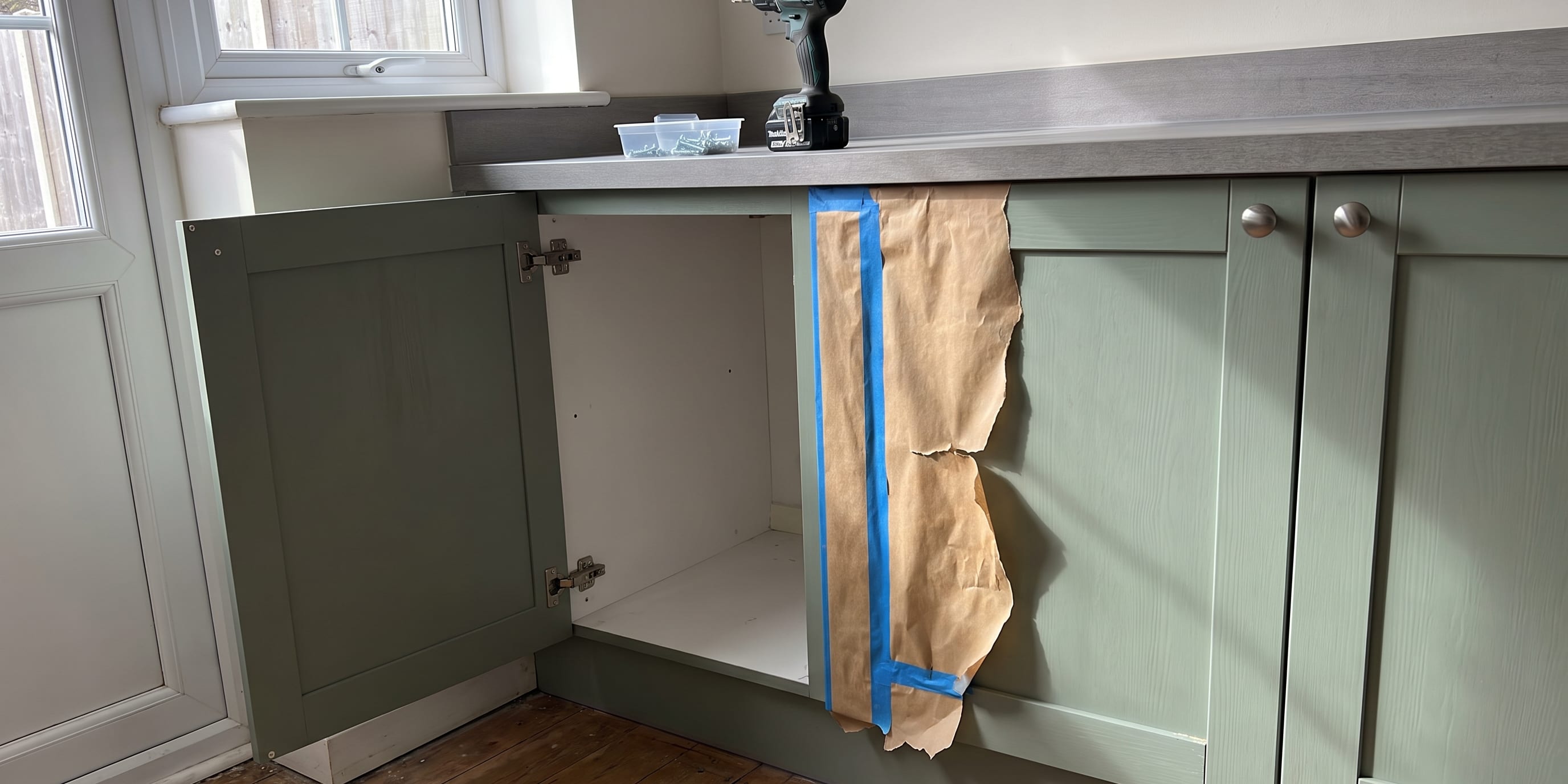
In-situ spraying means the kitchen is sprayed where it stands. Doors and drawer fronts stay on their hinges and runners, or come off and are sprayed on trestles in the room or in the garage. The space is sealed with sheeting and tape, extraction is set up to pull overspray out of the room, and everything that is not being painted gets masked.
Workshop or off-site spraying means doors, drawer fronts and any removable panels are unhinged, labelled, transported to a spray booth, sprayed flat and brought back to be refitted. The carcasses, plinths, cornices and end panels are then sprayed in place, because they cannot be taken anywhere.
Notice that second point, because it gets glossed over a lot. Even a full off-site job involves some in-situ work. Cupboard boxes are screwed to walls and to each other. Nobody removes those. So a workshop job is really a hybrid: the moving parts leave, the fixed parts get sprayed at home with masking and extraction anyway.
What comes off regardless
Whichever route you take, some things should never be sprayed in place.
Handles and knobs come off. Masking around a handle leaves a ridge of paint at the edge of the tape line and a strip of old colour underneath that shows the moment anyone lifts a finger to open the cupboard. Taking them off takes minutes and the difference is permanent.
Hinges are usually removed, or at least unclipped and taken out of the cup. Paint that builds up inside a hinge cup or on a mounting plate stops the hinge sitting flush when it goes back, and a door that is a millimetre out of line looks worse than a slightly imperfect paint finish. Soft close mechanisms are also easily gummed up.
Drawer fronts, where they are bolted to the drawer box rather than integral to it, are almost always taken off. They are quick to remove and much easier to spray flat.
If a contractor tells you they will simply mask around the handles and hinges and spray over the top, that is a shortcut, not a technique.
Where finish quality genuinely differs
Spraying a door flat on trestles or in a booth is easier than spraying it hanging in a kitchen, for reasons that have nothing to do with skill.
A flat door can be coated on the face, all four edges and the back in a controlled sequence. Gravity works with you rather than against you, so the paint lays out evenly and you can get a wetter, smoother coat before it starts to sag. A door hanging vertically in a cupboard run has an edge you can barely see, a back face you have to reach around, and a top edge that is at eye level or above.
That is where in-situ work most often falls short. The front of the door looks excellent, and then someone opens a cupboard and the inside face is still the original colour, or the trailing edge has a thin patch where the gun could not get square to it. Whether that bothers you is a fair question. Plenty of people genuinely do not mind an unpainted inner face, particularly if the original colour is a neutral white. Others open their cupboards a hundred times a week and would notice immediately.
A booth also gives cleaner air. Spraying in a domestic room means airborne dust from carpets, soft furnishings and the general life of a house, no matter how well you sheet up. Extraction reduces it a great deal, but a purpose built booth with filtered airflow starts from a better position. On high gloss and very dark colours, where every speck of dust shows, that difference becomes visible.
Where in-situ spraying wins
Off-site is not automatically better for your household, though.
In-situ keeps everything in one place. Doors are not transported, not stacked, not handled by anyone in a van, and cannot be lost, chipped in transit or mixed up between jobs. Nothing gets refitted a week later on the assumption the room has not moved in the meantime.
In-situ also copes with kitchens where the doors are not really removable in any sensible way. Bespoke or fitted units with pinned or glued panels, hand painted in-frame kitchens with integral fronts, doors with glass panels or leaded inserts that will not travel well, and integrated appliance panels can all be more risky to remove than to mask carefully and spray in place. The same applies to anything with a fragile or historic substrate where taking a fixing out may not be reversible.
And it can be quicker in overall elapsed time, because the whole kitchen is treated as one unit rather than being split into two workstreams that both have to finish before the job is done.
Disruption and timeline: the real trade off
This is usually the deciding factor.
With off-site spraying, you keep the use of your kitchen. Sink, hob, kettle and cupboards are all accessible, just without doors. You cook, you make tea, you live normally. The inconvenience is cosmetic and it is temporary. The trade off is that your kitchen has open shelving for the duration and the job cannot finish until the doors return, cure properly and get refitted and adjusted.
With in-situ spraying, the room is sealed and out of use while the work happens. Sheeting across doorways, extraction running, no cooking, no leaning on the worktop. It is more intense but generally shorter overall, and when the sheeting comes down the job is done.
Curing matters in both cases. Paint that is touch dry is not hard. Refitting doors before the coating has hardened is how you get hinge marks, fingerprints in the edges and doors that stick to their neighbours the first time they close. A sprayer who is honest about cure times will build that waiting into the schedule rather than pretending it does not exist, and it is one of the things worth clarifying when you compare quotes.
Questions to ask before you book
Whichever method a contractor proposes, these answers should be specific.
Which parts come off and which get sprayed in place? You want a clear list, not a vague "we take the doors away".
Are handles and hinges removed or masked? The answer should be removed.
Are the inner faces and edges of the doors included? Ask directly. Some quotes cover the visible front only, which may be perfectly fine for you, but you should know that before the job rather than after.
How is overspray controlled in my house? Look for sheeting, taping and mechanical extraction as standard, plus a plan for adjacent rooms, flooring and any route the team walks.
If doors leave the property, who is responsible for them? Labelling, transport, storage and insurance. A professional outfit will have a straightforward answer.
How long between last coat and refitting? And who adjusts the doors afterwards, because hinge alignment always needs a final tweak once everything is back on.
What happens if a door is damaged or the colour is not right? Any decent contractor expects that question.
So which should you choose?
If the finish on every visible surface matters to you, if you are going dark or high gloss, and if you can tolerate a spell of open shelving, off-site spraying of doors and drawer fronts with the carcasses sprayed in place tends to give the most controlled result.
If your kitchen has doors that are awkward or risky to remove, if you want the disruption over in one concentrated block, or if the front faces are the only surfaces you care about, well executed in-situ spraying is a perfectly sound choice. The masking and extraction have to be done properly, though, and that is the part where corners get cut.
There is no universally correct answer, only the right answer for your kitchen, your household and the standard you are paying for. The most useful thing you can do is stop asking whether the doors come off and start asking what happens to every surface in the room, one by one. Any sprayer worth hiring will walk you through it without hesitation. Whichever method suits your kitchen, it is one of several factors that move the price, covered in full in what actually decides a kitchen respray cost.
Or see the full kitchen respraying service first, if you’d rather read before you book.
Questions
Frequently Asked Questions
Do you have to take kitchen doors off to spray them?
Not always. Doors can be sprayed in place using masking and extraction, or removed and sprayed flat off-site. Both are legitimate professional methods, and the right one depends on the door construction, the finish you want and how much disruption you can live with.
Does spraying doors off the hinges give a better finish?
It gives better access. Spraying a door flat lets the sprayer coat the face, all four edges and the back in one controlled pass, with no risk of overspray drifting onto walls or worktops. On a well masked in-situ job the visible face can look just as good, but edges and back faces are harder to reach.
How long will my kitchen be without doors?
That depends on the paint system, the number of coats and how quickly each coat cures. Any contractor quoting for off-site work should give you a clear turnaround in writing before you commit, along with what happens if the schedule slips.
Can I use my kitchen while the doors are being sprayed?
With off-site spraying the carcasses stay put, so cupboards, the sink and appliances remain usable, just without doors. With in-situ spraying the room is masked off and out of use while coats are applied and cured.
Do handles and hinges have to be removed either way?
Handles, knobs and any surface mounted fittings should always come off rather than being masked around. Hinges are usually removed or partly dismantled too, because paint building up in a hinge cup or on a hinge plate causes alignment problems later.